


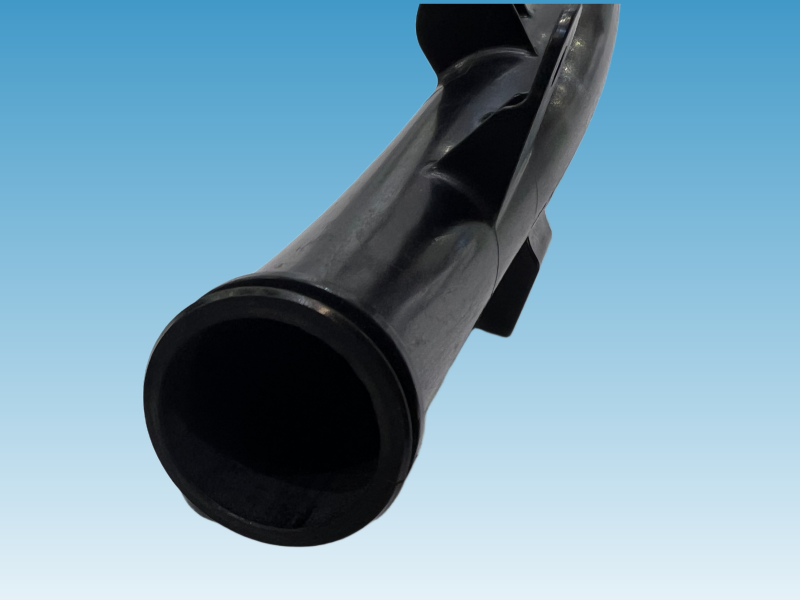
Gas Assisted vs. Conventional Injection Molding
Запрос- Описание
Gas Assisted vs. Conventional Injection Molding: Which Is Right for Your Part?
Conventional injection molding is the workhorse of plastics manufacturing. Gas-assisted injection molding (GAIM) is a specialized upgrade for parts with thick sections, strict weight targets, or sink-mark problems. This guide compares the two head-to-head so you can choose the right process for your part — and your budget.
Two processes, one result in mind
Conventional injection molding fills the cavity fully with plastic and packs it with pressure until the gate freezes. It is simple, well understood, and ideal for thin-wall and uniform-wall parts. Its limits show up on thick sections: sink marks, warpage, heavy weight, and long cooling times.
Gas-assisted injection molding (GAIM) injects nitrogen into the still-molten polymer after a partial fill. The gas creates a hollow channel in the thick section and keeps packing from the inside while the part cools. The result: lighter parts, fewer sink marks, and better dimensional stability on thick-wall geometry.
Head-to-head comparison
| Factor | Conventional molding | Gas-assisted molding (GAIM) |
|---|---|---|
| Wall thickness | Limited to avoid sink / warp | Can use thick structural sections |
| Part weight | Higher (solid packing) | Lower — hollow channel, typically 20–40% lighter |
| Sink marks | Common on thick bosses, ribs, hubs | Eliminated by internal gas packing |
| Warpage risk | Higher on thick parts | Lower — less internal stress, even cooling |
| Cycle time | Longer on thick sections | Shorter — thinner effective wall cools faster |
| Holding pressure | Required until gate freezes | Gas continues packing after gate freezes |
| Tooling complexity | Simpler | Requires gas channels, gas pins, venting |
| Unit cost (volumes) | Lower tooling, higher material | Higher tooling, lower material and energy |
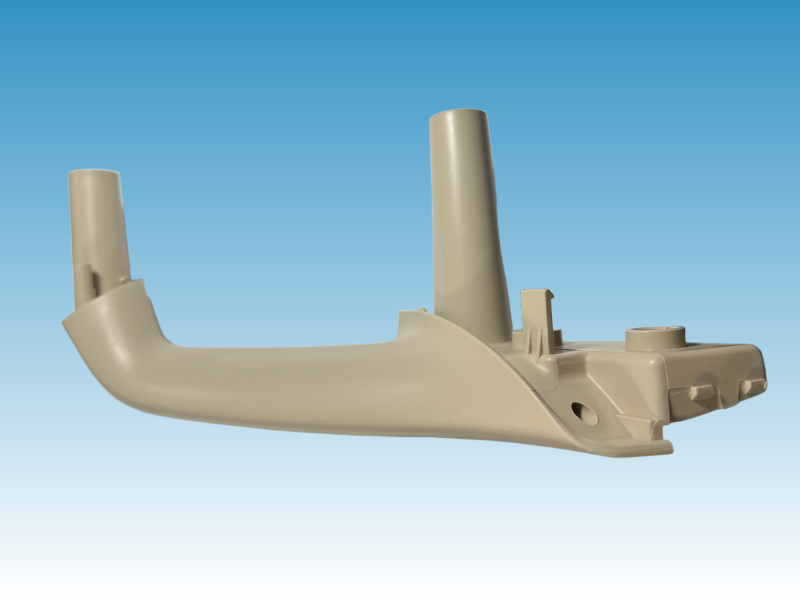
| Best for | Thin-wall, uniform, high-clarity parts | Thick ribs, handles, frames, beams, long parts |
Where conventional molding is limited — thick sections, heavy parts, sink-prone geometry — GAIM changes the physics so those sections can be lighter and cleaner.
When gas-assisted is the better choice
GAIM earns its tooling cost when the part design gives it something to work with. Consider GAIM when you need to:
- Remove sink marks on thick bosses, ribs, hubs and handles.
- Cut weight — hollowing thick sections can remove 20–40% of part weight.
- Reduce warpage on long, slender or thick-wall parts.
- Shorten cycle time on thick parts by cooling a thinner effective wall.
- Lower holding pressure and reduce clamp-force requirements.
- Add stiffness with hollow ribs instead of heavy solid masses.
When conventional is the better choice
Conventional molding stays the right, lower-cost choice in many cases. Prefer it when:
- The part is thin-wall or uniform-wall with no thick, sink-prone sections.
- You need high clarity or optical surface quality where a hollow channel adds nothing.
- The geometry gives no stable path for the gas — gas would finger or blow through.
- Quantities are low and the extra gas-pin tooling cost cannot be recovered.
- The part is small, simple, and light already — GAIM offers no benefit.
Cost and cycle-time reality
The honest comparison is total part cost, not just tooling. Two factors matter:
- Tooling: GAIM molds cost a little more — gas pins, gas channels and sealing add to mold construction.
- Per-part cost: GAIM uses less material, shorter cycles and lower energy, so per-part cost usually falls at production volumes on suitable parts.
Bottom line: on thick-wall, sink-prone parts, the material and cycle savings typically outweigh the extra tooling cost once volumes are meaningful. On thin-wall parts, the extra tooling cost has nothing to pay for itself.
How to decide — a practical checklist
Run your part through these questions. Three or more “yes” answers point toward GAIM.
Bottom line
Conventional molding is the default — simple, proven, and right for thin-wall, uniform parts. Gas-assisted injection molding is the upgrade when thick sections, weight, or sink marks are the problem. Choose GAIM when the part has a stable thick section and you can recover the tooling cost; choose conventional everywhere else.
At Газовая инъекция с поддержкой, we design and manufacture molds for both processes in our own factory, so you get an unbiased recommendation — not one process pushed on you.
Not sure which process fits your part?
Send your geometry, material and quantity. We will compare conventional vs. gas-assisted for your specific part and quote both options.
Get a process recommendation & quote
sales@gptmold.com · gasassistinjection.com
Блоги, Ресурс
ОТПРАВИТЬ ЗАПРОС
Сопутствующие товары
- Запросить предложение
LET’S TALK ABOUT YOUR PROJECT
From mold development to part production.
Share your drawing, material and expected production volume.
Gas assist injection molding and mold development by GPTMOLD.
Mold manufacturing and part production in our own factory.
About our companyContact
Tell us about your project.
sales@gptmold.comТель: +86 755 2308 9686
Contact our team
WhatsApp: +86 135 3051 6428