- Blogs
- Gas assist injection molding design guide
- gas assisted injection molding
- gas assist molding
- gas assist injection mold development
- gas assist injection molding services
- gas assist injection molding manufacturer
- gas assist injection molding applications
- gas assist injection molding materials
- gas assist injection molding

sales@gptmold.com


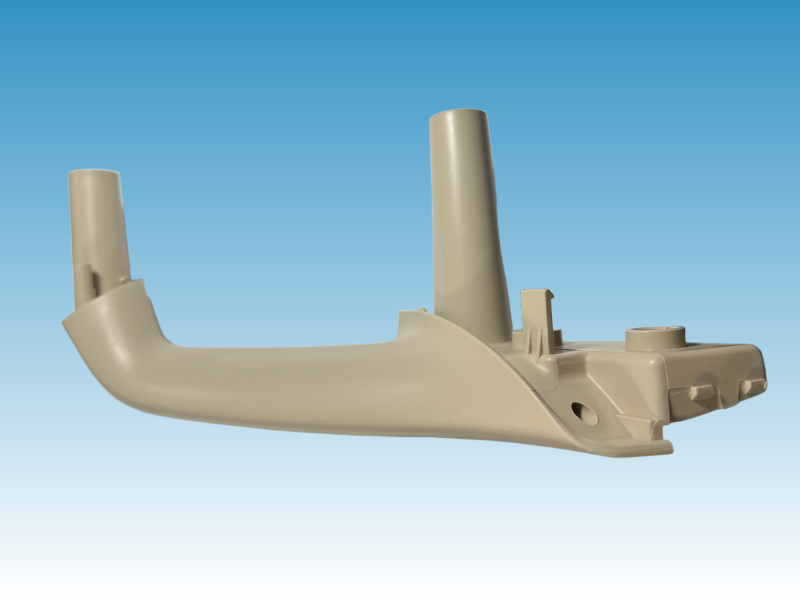
Material Selection for Gas Assisted Injection Molding
Inquiry- Description
Material Selection for Gas Assisted Injection Molding
Gas-assisted injection molding hollows out thick sections from the inside. That simple idea makes the polymer choice more important than in conventional molding: the material has to fill the part, hold a stable skin while gas pushes through, and keep enough stiffness once the core is hollowed. This guide explains what to look for and which materials work best.
In this article
01 · Why it matters
Why material matters more in GAIM
In GAIM, the gas pushes the still-molten core aside to form the hollow channel. The material therefore has to do three jobs at once:
- Fill the cavity well enough that gas only has to move a mobile, predictable melt front.
- Hold a skin that resists blow-through while the gas displaces the core.
- Carry the load — because the core is removed, the remaining skin and ribs must be stiff enough.
A material that is great in conventional molding can be frustrating in GAIM, and vice versa. Choosing the grade is not a footnote — it is a design decision.
Always specify the exact resin grade. Two grades of the same family can behave very differently in gas flow, shrinkage and stiffness.
02 · Key properties
Key material properties to evaluate
Flow & melt viscosity
- Good flow fills the part and lets gas move the core cleanly.
- High-viscosity resins need higher gas pressure and slower timing.
Melt strength
- Resists blow-through and gas fingering.
- A stable skin keeps the hollow channel in one defined path.
Shrinkage behavior
- Predictable shrinkage gives repeatable channel and dimensions.
- Material with low, even shrinkage is easiest to control.
Stiffness / modulus
- After hollowing, the skin and ribs carry the load.
- Higher modulus means hollow sections stay strong and rigid.
Processing window
- A broad temperature and pressure window makes gas timing forgiving.
- Thermally stable resins reduce cycle risk.
Cost & availability
- The savings from hollowing only matter if the resin is economical and reliable.
- Consider long-term supply for production programs.
03 · Recommended materials
Recommended material families
| Material | Why it suits GAIM | Typical GAIM uses |
|---|---|---|
| Polypropylene (PP) | Low viscosity, low cost, good flow, wide window | Handles, tool housings, thin ribs, consumer parts |
| ABS | Good surface, toughness, broad processing window | Housings, interior trim, appliance parts |
| PC / PC–ABS | High stiffness and impact; PC–ABS balances flow and strength | Structural parts, electronics, auto interior |
| PA6 / PA66 (often glass-filled) | High strength and stiffness for hollowed load paths | Beams, brackets, structural connectors |
| PBT / PET | Stiffness, dimensional stability, chemical resistance | Connectors, structural housings |
| HDPE | Good flow, chemical resistance, low cost | Tanks, frames, utility parts |
These are the families we most often mold with GAIM. Within each family, the exact grade still needs to be checked for melt strength, shrinkage and modulus before committing the tooling.
04 · Use with care
Materials to handle with care
- High-clarity / optical grades — a hollow channel can disturb light path or optics. Evaluate carefully; gas assist is not a default for clear parts.
- Brittle or low-melt-strength resins — the gas can break through the skin, causing blow-through or surface defects.
- Very high-viscosity or heat-sensitive resins — narrower processing window makes gas timing and channel control harder.
- Heavily filled grades — fillers change flow and shrinkage; the hollow channel behaves differently and warp risk needs review.
This is not a “do not use” list — it is an “evaluate first” list. Many of these materials work fine in GAIM with the right mold and process design.
05 · Fillers & additives
Fillers, additives & color
- Glass / talc fillers raise stiffness and reduce shrinkage, which often helps GAIM — but they change flow and can increase wear on gas pins and gates.
- Impact modifiers improve toughness but can narrow the processing window slightly.
- Colorants are generally fine; the important thing is to specify the exact filled/unfilled grade so shrinkage and flow are known.
Whatever the recipe, the grade must be defined up front — a GAIM mold is designed around the material’s flow and shrinkage.
06 · How to choose
How to choose — a quick checklist
Run your candidate material through these questions before locking the tooling.
?
Fills well?Does the grade flow well enough at the target wall thickness?
?
Holds a skin?Does it resist blow-through while gas displaces the core?
?
Shrinkage known?Is shrinkage predictable and even for repeatable channels?
?
Stiff enough?Does the remaining skin and ribs meet the load with a hollow core?
?
Stable & available?Is the exact grade consistent and available for production?
?
Cost-effective?Does the resin make the hollowing savings worthwhile?
07 · Bottom line
Bottom line
The best GAIM materials combine good flow, stable melt strength, predictable shrinkage and enough stiffness to survive hollowing. PP, ABS, PC, PC/ABS, glass-filled PA, PBT, PET and HDPE are the families we mold most often. Clarity grades, brittle resins and heavily filled materials deserve a feasibility check before tooling is cut.
At Injection assistée par gaz, we recommend the material as part of the project evaluation — not in isolation — so flow, warp, cost and the gas channel are decided together.
Unsure which material works for your part?
Tell us the part function and send your geometry. We will recommend a grade, check it against the gas-channel design, and quote the mold and production.
Get a material & process recommendation
sales@gptmold.com · gasassistinjection.com
Blogs, gas assist injection molding materials, Ressources
ENVOYER UNE DEMANDE
Produits connexes
- Demander un devis
LET’S TALK ABOUT YOUR PROJECT
From mold development to part production.
Share your drawing, material and expected production volume.
Gas assist injection molding and mold development by GPTMOLD.
Mold manufacturing and part production in our own factory.
About our companyContact
Tell us about your project.
sales@gptmold.comTel: +86 755 2308 9686
Contact our team
WhatsApp: +86 135 3051 6428
© GPTMOLD 2024. Tous droits réservés